First: what this guide is, and what it isn’t
Let’s be clear before anything else, because parents in your position have heard too much marketing already.
This is not medical advice. Teaching methods are not therapy, and no Quran teacher — however skilled — replaces the speech therapist, occupational therapist, or specialist your child may need. If your child is under professional care, everything here sits alongside that care, never instead of it.
What this guide is: a practical, experience-based approach to helping a child with special needs build a real, positive relationship with the Quran and the Arabic language — adapted to how their brain actually works, not to how a standard classroom wishes it would.
Start here: every child is different — so start by understanding yours
The single biggest mistake in most advice about teaching the Quran to a child with special needs is treating “special needs” as one thing. It isn’t. A child with ADHD, a child on the autism spectrum, and a child with dyslexia need three genuinely different approaches — and getting this right from the start saves months of frustration.
Before you choose techniques, notice which patterns fit your child best:
- Attention and focus challenges (common with ADHD): Your child can learn, but not for long stretches. They fidget, get up, hyperfocus on one detail then lose the thread. They may read a word perfectly, then forget it minutes later. Their learning comes in bursts.
- Sensory and routine needs (common with autism): Your child is sensitive to sound, light, or unexpected change. They crave predictability and can be overwhelmed by a busy environment. They may process visuals far faster than spoken words, and eye contact may be uncomfortable.
- Reading and processing differences (like dyslexia): Your child sees letters differently — reversed, moving, or hard to hold steady. They may be bright and verbal but struggle specifically with decoding text.
Most children don’t fit one box neatly, and many have a blend. That’s normal. The point isn’t to diagnose your child — it’s to teach the child in front of you, not a generic “special needs” template.
The techniques that actually work (and why)
Across every learning profile, a handful of adaptations make the biggest difference. These aren’t tricks — they’re established teaching accommodations used in special education worldwide.
Short, focused sessions — 10 to 20 minutes
A 45-minute lesson is built for a neurotypical adult, not your child. Break learning into short, focused bursts — even 10 minutes of genuine engagement beats 40 minutes of struggle. Two short daily sessions almost always outperform one long weekly one.
Visual anchors over spoken instruction
Many children with special needs process what they see faster than what they hear. Colour-coded letters, flashcards, letters shown inside familiar words, and a simple visual schedule showing “what comes next” reduce anxiety and hold attention far better than verbal explanation alone.
Repetition with warmth, never with pressure
Repetition is how the Quran was preserved and how it sticks for every learner — but for a child with special needs, it must feel safe. Recite a short verse, have your child repeat it, celebrate the attempt, and return to it tomorrow. Correction should feel like gentle guidance, never like failure.
Movement and sensory breaks — built in, not banned
For a restless child, movement isn’t misbehaviour to suppress; it’s a need to work with. A short stretch, a sip of water, standing up between segments — these reset focus rather than breaking it. A fidget object in the hand often helps a child listen better, not worse.
Predictable structure
Same time, same place, same order every session: greeting, warm-up, new learning, break, practice, close. Predictability frees your child’s mental energy for the actual learning instead of spending it on uncertainty.
Immediate, specific praise
“You’ll feel proud later” doesn’t land. “You read that whole letter perfectly — well done!” does. Frequent, immediate, specific encouragement is the fuel that keeps a struggling learner coming back.
Setting up the environment at home
Where your child learns matters as much as how. A few adjustments transform a session:
- Quiet and calm: a room with the door closed, TV off, phones away, siblings elsewhere.
- Soft lighting: avoid harsh overhead fluorescents, which many sensory-sensitive children find distressing.
- Comfortable seating: whatever keeps your child regulated — a chair, a cushion, a rocking seat. Let them shift position if they need to.
- The right time of day: every child has a focus window — often mid-morning after breakfast, rarely right after school or before bed. Find your child’s window and protect it.
Being honest about progress
Here’s what most pages won’t tell you: a child with special needs often progresses more slowly through structured content than their peers — and that is completely normal, not a sign of failure.
Progress rarely looks like a straight line. It looks more like a staircase with plateaus: weeks where everything clicks, followed by weeks where nothing seems to. The first month is often about building trust and routine, not covering content. Recognition of letters, comfort with the process, and a child who doesn’t dread the lesson are real wins — even before a single surah is memorised.
Interestingly, many children on the autism spectrum have unusually strong auditory memory, and often memorise short surahs through listening and repetition more easily than they read. Play to your child’s strengths rather than forcing the standard order.
The parent’s role — you’re not a spectator
Whether you teach your child yourself or work with a tutor, your role is central. Consistency, encouragement, and a calm home atmosphere do more for a special needs learner than any single technique. Keep sessions positive, end every one on something your child did well, and never let a hard day convince you the whole effort is failing. Hard days are part of it.
When home teaching isn’t enough — and where to turn
There is no shame in reaching the limit of what you can do alone. Most parents do — especially when they can’t read Arabic confidently themselves, or when their child simply learns better from someone who isn’t their parent (which is extremely common). The wisest move is often to bring in a tutor trained specifically for your child’s profile, while you provide the consistency and love at home.
This is exactly where specialised one-to-one teaching makes the difference — because the approach has to match the child:
- If your child’s main challenge is attention and focus, look for teaching built around short bursts, movement, and immediate reinforcement — the approach behind our Quran classes for children with ADHD.
- If your child is on the autism spectrum and needs sensory-aware, visual-first, predictable lessons, look for tutors trained in that specific approach — the foundation of our Quran classes for autistic children.
- If your child needs Arabic language support adapted to dyslexia, speech delays, sensory needs, or a combined profile, an individualised plan matters most — which is how our special needs Arabic classes are structured.
What all three share: fully one-to-one lessons (never groups), tutors trained in adaptive teaching, the freedom to choose a male or female tutor, and progress measured against your child’s own baseline — not against other children.
A note for non-Arabic-speaking families
If Arabic isn’t spoken in your home, you might worry that teaching the Quran to a child with special needs is beyond you. It isn’t. Lessons taught in clear English, daily audio recitation your child can absorb passively, and a qualified tutor handling the pronunciation you’re unsure of — together these close the gap. You bring the consistency and the love; the right support fills in the rest.
The most important thing to remember
A child who reads slowly but feels safe, loved, and capable during Quran time has everything that matters. Fluency can come later. The relationship your child builds with the Quran now — whether they’re memorising, recognising letters, or simply finding calm in its recitation — is worth more than any timeline.
If you’ve reached the point where you’d like specialist support, a free trial lesson is the gentlest way to see how adaptive, one-to-one teaching works for your child — with no pressure and no commitment. You don’t have to carry this alone.
FAQ:
Can a child with special needs really learn the Quran?
Yes with the right approach. Children with ADHD, autism, dyslexia, and other learning differences can all build a genuine relationship with the Quran when teaching is adapted to how they learn: short sessions, visual support, gentle repetition, and a calm environment. Progress may be slower than for other children, and that’s completely normal. Even non verbal children can connect with the Quran through listening, recognition, and auditory memory
How long should a Quran session be for a child with special needs?
Usually 10 to 20 minutes, adjusted to your child’s attention span. Two short daily sessions almost always work better than one long weekly one. Never force a longer session than your child can genuinely handle — pushing past their limit creates resistance rather than progress. As comfort and routine build over time, sessions naturally lengthen.
Do teachers need special training to teach the Quran to a child with special needs?
It makes a significant difference. A tutor trained in adaptive, special-needs-aware teaching knows how to use visual schedules, movement breaks, sensory calibration, and positive reinforcement — and how to respond calmly to a difficult day. They are teachers, not therapists, and work alongside any professional support your child receives rather than replacing it.
My child hasn’t been formally diagnosed. Can they still get this kind of teaching?
Yes. Many parents recognise clear learning differences in their child without a formal diagnosis. You know your child best. If traditional Quran or Arabic classes have consistently been a struggle and you believe adapted teaching would help, that’s reason enough. A formal diagnosis is not required to enrol in adaptive, one-to-one lessons.
What if my child has a meltdown during a lesson?
It happens, and it isn’t a failure. A well-trained tutor pauses the content, shifts to something calming, and gives your child space to regulate — ending the session early if needed, with no shame or criticism. Your child returns to the next lesson welcomed, not judged. Meltdowns are part of the reality of learning with special needs, and the right teaching treats them that way.
Quran Classes for Children with ADHD
For the parents who’ve tried three courses already and watched their child give up on each one — this is built differently. Our Quran classes for children with ADHD are live, one-to-one, and structured around how ADHD brains actually learn: short focused bursts, movement breaks, visual anchors, and patient tutors who don’t take it personally when the day is hard. Not a therapy program. Not a promise of overnight change. A Quran learning environment that finally fits your child.

Special Needs Arabic Classes
Every child deserves a real path to Arabic — not a diluted version of a course designed for someone else. Our special needs Arabic classes are one-to-one, adaptive, and built around your child’s specific learning profile: autism, ADHD, dyslexia, speech delays, sensory processing differences, or a combination. Live tutors trained in inclusive teaching. Individualized learning plans. Zero pressure. And an honest promise: your child’s pace is the right pace.
Quran Classes for Autistic Children
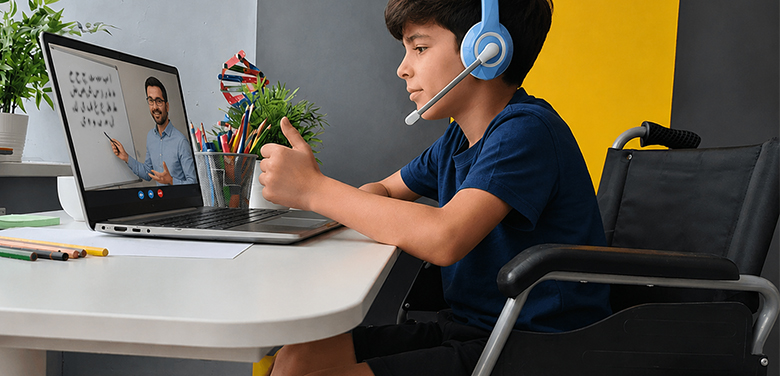
Every autistic child is different — so a course that works has to be different too. Our Quran classes for autistic children are one-to-one, sensory-adapted, and built around your specific child’s profile: verbal or non-verbal, sensory-sensitive or sensory-seeking, academic-focused or exposure-focused. Live tutors trained in autism-aware teaching methods. Visual schedules. Predictable routines. Zero pressure. And an honest promise: we start where your child actually is, not where a curriculum says they should be.