You’ve made the decision — your child should learn Arabic. Now comes the harder question: how do you make sure the course you choose actually works?
Because here’s what most parents don’t realise until it’s too late: 90% of Arabic classes for kids are just Arabic classes for adults, delivered slower. Same textbook logic. Same drill-and-repeat. Same passive receiving. And within three months, most kids either hate the language or forget the whole thing. Our Arabic classes for kids online are engineered on a different principle — one that pediatric language research has been showing us for decades. This page explains what that principle is, how it changes everything, and why it matters for your child.
The science parents rarely hear about (and it changes everything)
Children’s brains have a property called neural plasticity — the ability to absorb languages, sounds, and patterns almost effortlessly. This plasticity is at its peak in the first decade of life and gradually decreases after age 10.
Practically, that means:
- A child who starts Arabic at age 5 acquires its sounds and rhythm in a fundamentally different way than an adult starting at 25.
- Native-like pronunciation — including tricky letters like ع، ح، ق، غ — is far more achievable before age 10.
- Grammar and sentence patterns settle into intuitive memory rather than being consciously “learned.”
- The child ends up with a ceiling for fluency that adults simply can’t reach later.
The takeaway isn’t “hurry up.” It’s this is the easiest it will ever be — for you and for them. Every year you wait, the effort required to reach the same outcome grows. Which is exactly why an arabic tutor for kids who understands this window is worth ten times a general Arabic teacher.
Who our Arabic classes for kids are for
- Children ages 4 to 14 — from absolute beginners to intermediate readers.
- Kids in non-Arabic-speaking families where Arabic isn’t heard at home.
- Children of Arab parents growing up abroad and losing touch with the language.
- Muslim families who want their kids to understand the Quran through the language it was revealed in.
- Kids preparing for Islamic school, Quran classes, or Sunday school programs.
- Children with Arabic-speaking grandparents they want to talk to properly.
- Teenagers building Arabic for future travel, study, or work in the MENA region.
No prior Arabic is required — most of our students start at zero.
The Age-by-Age Framework — why one method doesn’t fit all children
This is where most Arabic classes for kids go wrong. A five-year-old and a twelve-year-old need completely different pedagogies. Trying to teach both the same way produces the same result: neither one thrives. Here’s how our arabic for kids online course is structured for each age band.
Ages 4–6 — The Sound Absorption Years
At this age, children don’t learn language — they absorb it. Lessons are 25–30 minutes maximum (that’s the honest attention-span limit, and any course claiming longer sessions at this age is fighting biology). Content is entirely play-based: songs, colourful characters, animated stories, call-and-response games, and short repeatable phrases. The goal isn’t reading or writing — it’s ear training. Getting the sounds of Arabic into their memory before their brain closes to new phonetics.
Ages 7–9 — The Foundation Years
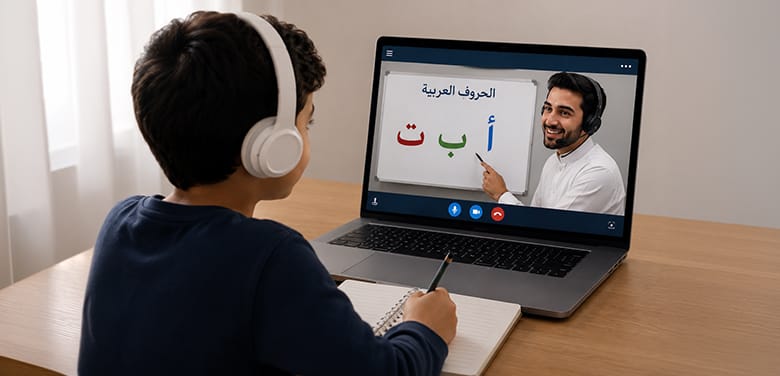
Now the child can sit for a proper 30–45 minute lesson and begin structured learning. The Arabic alphabet is introduced through meaningful words — ب appears in بيت (house), ت in تفاحة (apple) — never as isolated drills. Reading and writing begin together with speaking. Games and stories remain the primary vehicles, but with real curriculum content underneath. Children at this age can start reading simple sentences within 8–12 weeks of consistent lessons.
Ages 10–12 — The Building Years
Attention span extends to 45–60 minutes. Children can now handle grammar concepts, build sentence structures deliberately, and engage in real conversation practice. Reading fluency becomes a serious goal. This is the age where many of our students transition from “Arabic student” to “Arabic user” — writing short stories, understanding cartoons in Arabic, and reading books at their level.
Ages 13+ — The Independence Years
Teenagers can be taught closer to how we teach adult beginners — but with awareness that they still benefit from more engaging content, more meaningful projects, and less pure drill. This age group progresses fastest of all when motivated, because they combine the neural advantages of youth with adult-level reasoning ability.
Your child’s arabic tutor for kids is trained specifically for the age they teach — not a generalist stretched across the entire age range.
The Parent Anxiety Map — five real concerns, honestly addressed
Every parent asking about Arabic classes for kids has the same set of worries. We’ll address them directly rather than pretending they don’t exist.
Anxiety 1 — “Will my child actually learn, or just play?”
The false dichotomy of play versus learning is the biggest myth in kids’ education. Research is unambiguous: children learn best when they play. What matters is whether the play has clear educational goals underneath it. Our lessons look like games. They are structured curriculum with measurable milestones. Your tutor tracks progress lesson-by-lesson and reports it to you monthly — so you always know what your child has actually mastered.
Anxiety 2 — “What if my child ends up hating Arabic?”
This is the single most common outcome of the wrong course — and the single biggest tragedy, because a child who “hates Arabic” at 8 often never returns to it as an adult. The prevention is straightforward: never let a lesson feel like punishment, never push past attention limits, never shame mistakes, always end on a win. Our tutors are trained on all four. You’ll see the difference in the first trial.
Anxiety 3 — “Will they actually retain it, or forget everything?”
Retention is a function of consistency and reinforcement, not talent. Two 30-minute lessons per week + 10–15 minutes of daily light exposure (a song, a game, five flashcards) is what turns temporary knowledge into permanent skill. We provide the parent guide for exactly this daily reinforcement.
Anxiety 4 — “Is the environment safe and appropriate for my child?”
Every lesson is one-to-one in a private, monitored video call. Parents are welcome to sit in on any session — many do for the first few classes, both for reassurance and to help younger children settle. Male and female tutors are available, so you can choose exactly who your child works with.
Anxiety 5 — “Am I wasting money on something that might not work?”
The free trial exists specifically to remove this risk. You see the tutor, watch how your child responds, get an honest assessment, and only then decide. If your child doesn’t connect with the tutor, we match them with a different one — no charge, no drama.
The Learning-Through-Play Framework — four teaching methods that actually work
“Play-based learning” is a phrase every arabic for kids online course uses. Here’s what it actually means in a real lesson.
1. Interactive Games
Word-matching, drag-and-drop, hide-and-reveal, memory pairs. Every new vocabulary word gets embedded through 3–5 different game formats until the child owns it. Games work because children willingly repeat what feels fun — and repetition is the engine of language learning.
2. Songs and Rhymes
Children remember tunes long after they forget instructions. Arabic nursery rhymes, alphabet songs, counting chants, and short thematic tunes make vocabulary practically impossible to forget. Music also trains the ear to Arabic rhythm and intonation.
3. Stories and Role-Play
Kids don’t want vocabulary lists. They want to know what happens next. Short stories with recurring characters give your child a reason to learn each new word — because they need it to follow the story. Role-play then puts those words into their own mouth.
4. Visual Learning
Colourful flashcards, illustrated books, animations, and thematic scenes (a market, a beach, a birthday party) tie every Arabic word to a real mental image. Children learn الشمس (the sun) faster when they see a smiling sun than when they read the translation.
In practice, every lesson blends all four. That variety is what keeps a child’s attention through a 30-minute session and eager for the next one.
For non-Arabic-speaking families — how it works when Arabic isn’t heard at home
This is the hardest case, and it deserves its own section. If your family speaks English (or French, Urdu, Turkish — anything but Arabic), you might reasonably wonder whether Arabic classes for kids online can actually work without home reinforcement. The honest answer: yes, with the right structure. Here’s what actually makes the difference.
- Immersive lessons — sessions are conducted with progressively more Arabic as your child’s comprehension grows. By month three, more than half of the lesson runs in Arabic naturally.
- Parent guide for non-Arabic speakers — a short weekly document showing what your child learned and 5 simple Arabic phrases you can use at home (bath time, meal time, bedtime) without speaking Arabic yourself.
- Arabic media plan — curated cartoons, songs, and short videos matched to your child’s level, integrated into their week.
- The 10-minute daily habit — a small consistent exposure between lessons that makes retention four times stronger, delivered through content your child actually wants to engage with.
Thousands of children raised in non-Arabic-speaking households have built genuine Arabic fluency through structured online lessons. It requires slightly more parental support than an Arabic-speaking home would provide — but not fluency in Arabic yourself.
Three warning signs your child’s Arabic course isn’t working
Whether you choose our program or another, here’s how to tell — within the first month — whether the course is actually working. Bookmark this list.
Warning Sign 1 — Your child dreads the lesson.
Some resistance is normal (kids resist everything). But if your child is consistently upset before class or fights it every time, the course is wrong for them. Right course = your child sometimes asks if it’s Arabic day.
Warning Sign 2 — Nothing “sticks” outside the lesson.
By week 4, your child should recognise Arabic words on flashcards, sing a simple song, or use one or two greetings unprompted. If nothing is transferring outside the class, the teaching method isn’t reaching them.
Warning Sign 3 — You get vague progress reports.
“Your child is doing great!” is not a progress report. You should hear specifics: which letters they now recognise, which words they now use, what they’re working on next. If the tutor can’t tell you clearly, they’re not tracking it.
Our program is built around the opposite of all three. Your child looks forward to lessons, transfers what they learn to daily life, and you get concrete monthly progress reports with specific mastered skills. If any of that isn’t true after your first month, we recalibrate — or refund.
Your child’s Arabic journey, level by level (organised by age)
Because children progress by developmental stage — not by lesson number — our arabic classes for kids are structured by age band. Your child enters at the level matching their age and current ability.
 Level 1
Sounds, Songs & First Words
- Ear training through Arabic songs, rhymes, and short stories.
- First 50 spoken words: family, colours, animals, greetings.
- Playful pronunciation drills for tricky Arabic sounds.
Level 2 Alphabet Recognition & Playful Reading
- Recognise all 28 Arabic letters through stories and characters.
- Match letters to sounds through interactive games.
- Read first simple words with the letters they’ve learned.
Level 3 Structured Reading & Writing
- Read short sentences and simple stories in Arabic.
- Write letters, words, and short phrases.
- Apply harakat (vowels), sukoon, and shaddah correctly.
Level 4 Conversation & Vocabulary Building
- Hold 5–10 minute conversations on familiar topics.
- Learn 300+ words across daily themes (school, food, family, animals).
- Understand cartoons and short stories at their level.
Level 5 Grammar & Independent Reading
- Grammar foundations — Nahw and Sarf at an age-appropriate pace.
- Read short books, articles, and stories independently.
- Write journal entries, stories, and structured essays.
Book a free trial — see how your child responds before you commit
The free trial exists to remove your risk. Book a session, watch how your child engages, ask the tutor anything, and only then decide. If the tutor isn’t a fit, we rematch — no charge. Most parents leave the first trial with the same reaction: “I’ve never seen my child pay attention like that.” That reaction is what a good arabic tutor for kids actually looks like.
What your child will be able to do
- Recognise, read, and write Arabic letters and words at their age level.
- Hold real conversations on daily-life topics in Arabic.
- Understand cartoons, stories, and songs in Arabic.
- Approach the Quran with real linguistic access (not just recitation).
- Talk to Arabic-speaking family members with confidence.
- Continue easily into Quran classes, Islamic studies, or advanced Arabic later.
Why parents choose Quran Lights for their child’s Arabic classes
Age-specialised tutors, not generalists
Your child’s arabic tutor for kids is specifically trained for their age band — not a general Arabic teacher stretched to teach five-year-olds one day and adults the next. This is the biggest single quality difference in kids’ online Arabic education.
One-to-one only — never group classes
A group class of even 5 children means each child gets ~6 minutes of active attention per hour. In our one-to-one lessons, your child has the tutor’s full attention for the entire session. That’s the difference between a child who “attends Arabic” and a child who learns Arabic.
Proper play-based methodology
Games, songs, stories, and visual learning — all delivered as structured curriculum with measurable milestones. Your child looks forward to the lesson, and you can point to specific skills mastered each month.
Choose a male or female tutor
Male and female tutors are available across all ages. Female tutors especially popular for younger children and daughters. Your choice, from the first lesson.
Parents welcome to observe
You can sit in on any class. Many parents do so for the first few sessions, both for reassurance and to learn along with their child. Nothing is hidden. Nothing is off-limits.
Flexible after-school and weekend scheduling
Book Arabic classes for kids online around school, homework, and family life. Weekend, after-school, and evening slots available across UK, US, Canada, Europe, Gulf, and Asian time zones.
Clear monthly progress reports
Every month, you receive a specific report on exactly what your child has mastered, what they’re working on, and what comes next. Vague “doing great” reports don’t help you — concrete milestones do.
 Start Learn